
Tata Motors was the biggest loser in the Sensex pack, tumbling 2.47 per cent, followed by Reliance Industries (2.44 per cent), Maruti (1.84 per cent), SBI (1.76 per cent) and Bajaj Finance (1.23 per cent).
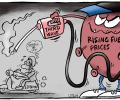
A surge in international oil prices may translate into an increase in the retail selling price of petrol and diesel in India as oil companies face extreme margin squeeze, sources said. Petrol and diesel prices have remained unchanged for 12 days but now the international rate surge is exerting pressure. Current prices of petrol and diesel in the international market are higher by around $4-6 per barrel as compared to average prices during August. However, no increase in retail prices has been affected by oil companies so far, sources said.

Pencilling in a GDP growth in third and fourth quarters, SBI Research on Wednesday revised its contraction forecast for the current fiscal year to 7 per cent. The agency had earlier forecast a 7.4 per cent contraction in 2020-21 GDP numbers. In April-September, the economy contracted 15.7 per cent but the second half may see a surprise 2.8 per cent growth, if the SBI analysis turns out to be correct.

India will also play an increasingly important role as one of the Asia-Pacific region's major economic growth engines, helping to drive Asian regional trade and investment flows.

According to Korn Ferry Global Salary Forecast, India's salary growth for 2020 stood at 9.2 per cent. down from 10 per cent last year, while real-wage after adjusting inflation may remain constant at 5 per cent in 2020.

American brokerage firm Morgan Stanley on Thursday sharply cut its India FY23 real GDP growth estimate to 7.9 per cent, mainly due to the impact of the Russia-Ukraine conflict on oil prices. Analysts at the brokerage also raised their inflation forecast to 6 per cent - the upper end of the tolerance band for the RBI - and flagged stagflation risks because of the ongoing events. "We believe that the ongoing geopolitical tensions exacerbate external risks and impart a stagflationary impulse to the economy," they said. It can be noted that stagflation involves a stagnancy in output or growth, coupled with high inflation.

Sliding for the fourth straight day, the BSE Sensex shed 152 points in choppy trade on Wednesday amid mixed global cues ahead of the US Federal Reserve's policy decision.

Production grew by a mere 0.5 per cent year-on-year, a significant comedown from the 3.5 per cent clocked in June.

Pakistan was "drowning" in debt and it was the new government's job to "sail this ship ashore," Prime Minister Shehbaz Sharif said on Wednesday.

RBI Governor Shaktikanta Das said that early containment of the pandemic could impart an "upside" to the economic growth outlook.

India's services sector activity continued to expand in September, supported by favourable underlying demand amid the easing of COVID-19 restrictions, but lost some momentum from August's 18-month high level, a monthly survey said on Tuesday. The seasonally adjusted India Services Business Activity Index fell from 56.7 in August to 55.2 in September, but remained well above its long-run average. "Despite easing from August, the rate of expansion was marked and the second-fastest since February 2020," the survey said.

The BJP still does not have a majority in Upper House of Parliament, the Rajya Sabha, and this will pose hurdles to the party's legislative reform agenda

'While we note the very strong cyclical recovery in the economy, we believe there is still uncertainty over medium-term prospects.'

RBI Governor would like to wait till Budget before taking any action on rate front.

The government's second round of stimulus will spur consumer spending in the near term but support to economic growth will be minimal, Moody's Investors Service said.

In the Sensex pack, HDFC, ONGC, Bharti Airtel, Titan, Asian Paints, Mahindra and Mahindra and TCS were the prominent gainers. On the other hand, ICICI Bank, IndusInd Bank, NTPC, UltraTech Cement, Tech Mahindra and SBI were among the major laggards. On the other hand, HCL Tech, Tech Mahindra, HUL, Bharti Airtel and ICICI Bank were trading in the red.

Rating agency Crisil on Friday said growth rates witnessed in the current fiscal in several sectors are expected to continue for 3-5 years, even as it predicted rising wages in the information technology sector by 2007-08.

Leading economists have pencilled in a high 13-15.7 per cent uptick in the economy in the first quarter of 2022-23 with an upward bias. Soumya Kanti Ghosh, the group chief economic adviser at State Bank of India, on Tuesday said he expects the GDP to clip past 15.7 per cent in the first quarter with more chances of the final numbers printing in higher, while Aditi Nayar, the chief economist at the rating agency Icra, said the economy will grow much lower at 13 per cent in the June quarter. The national statistical office will announce the first quarter GDP numbers later next week.

The cost of not vaccinating the entire population quickly will be far higher than bearing the entire cost of vaccination, points out Prosenjit Datta.

After sinking 586 points during the day, the 30-share index ended 503.62 points, or 1.29 per cent, lower at 38,593.52. The broader NSE Nifty plunged 148 points, or 1.28 per cent, to 11,440.20.

Chief Economic Advisor Krishnamurthy Subramanian said India's economy will witness a decline in the current fiscal, but the drop will be limited if there is an economic recovery in the October-March period.

Most forecasts do not have a track record of transparency and accuracy

It had upped India's rating to Baa2 from Baa3 and changed its rating outlook to 'stable' from 'positive', saying the reforms would help stabilise rising levels of debt.

For 2021-22, it projected the economy to clock a growth of 10.6 per cent.

IMF said in 2017, India is likely to grow at the rate of 7.2 per cent instead of the earlier projected 7.6 per cent.
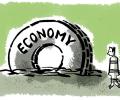
Moody's Investors Service on Friday projected India's growth at zero per cent for the current fiscal and said the negative outlook on sovereign rating reflects increasing risks that GDP growth will remain significantly lower than in the past. The outlook also partly shows weaker policy effectiveness to address economic and institutional issues, it noted in the update to its November 2019 rating forecast.
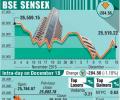
The S&P BSE Sensex lost 285 points to end at 25,519.

While efforts are being mounted on a war footing to arrest its spread, COVID-19 will impact economic activity in India directly through domestic lockdown. The second-round effects, it said, would operate through a severe slowdown in global trade and growth.

The finance minister is ready to present a second financial package. The Centre has ruled out a mega stimulus and will rely on targeted, incremental packages. Industry is clamouring for a bailout, the liquidity upheaval in capital markets is nowhere close to being sorted out, and all budgetary forecasts now stand irrelevant, reports Arup Roychoudhury.

Portfolio returns, say analysts at Morgan Stanley, are more likely to be driven by bottom-up stock-picking rather than top-down macro forces.

The US Federal Reserve on Wednesday (local time) raised interest rates by 75 basis points (bps) or three-quarters of a percentage point in the boldest move since 1994.

Fitch Solutions on Thursday said the new climate targets announced at the COP26 summit by Prime minister Narendra Modi pose an upside risk to its outlook for renewable growth in the country. With the new targets, it expected to see attempts to alleviate the issues regarding supply chains, manufacturing and project development that have long plagued renewable proliferation.

Equity benchmarks extended their decline for the fourth straight session on Wednesday, with the Sensex falling 214.85 points after the Reserve Bank raised the key interest rate by 50 basis points. Continuous foreign fund outflows and surging crude oil prices also weighed on markets. The 30-share BSE benchmark dropped 214.85 points or 0.39 per cent to settle at 54,892.49.

'We have lived through 10% plus inflation in India and we are aware of the economic pitfall.' 'With the RBI now having formally adopted an inflation target range, they cannot turn a blind eye to the impending risks.'

India's gold demand increased by 19.2 per cent to 76.1 tonne during the April-June quarter this year, largely due to low base effect, owing to the nationwide lockdown that hit economic activity last year, the World Gold Council (WGC) said in a report. The overall gold demand during the second quarter of 2020 calendar year stood at 63.8 tonnes, according to the WGC's 'Gold Demand Trends Q2 2021' report. In value terms, India's gold demand witnessed 23 per cent growth during April-June quarter at Rs 32,810 crore, compared to Rs 26,600 crore during the corresponding period of 2020.

Rajan also said the outlook for agriculture is subdued, in view of both rabi and kharif prospects being hit by monsoon vagaries.

The IMF said global growth is projected to reach 3.9 per cent in 2018 and 2019, in line with the forecast of the April 2018 WEO, but the expansion is becoming less even, and risks to the outlook are mounting.

India's GDP is estimated to contract by a record 7.7 per cent during 2020-21 as the COVID-19 pandemic severely hit the key manufacturing and services segments, as per government projections released on Thursday. Amid overall decline in economic activities, some respite was provided by the agriculture sector and utility services like power and gas supply, which have been projected to post positive growth during the current fiscal ending March 2021.

India's services sector activities contracted further in June as the intensification of the COVID-19 crisis and reintroduction of containment measures restricted demand, a monthly survey said on Monday. The seasonally adjusted India Services Business Activity Index fell from 46.4 in May to 41.2 in June, as new work intakes and output contracted at the fastest rates since July 2020, which prompted companies to reduce employment again. Subdued demand conditions resulted in a second successive monthly drop in new business received by services firms.
Moody's Investors Service on Friday slashed its estimate of India's GDP growth during the 2020 calendar year to 2.5 per cent from an earlier estimate of 5.3 per cent, on account of the rising economic cost of the coronavirus pandemic.
